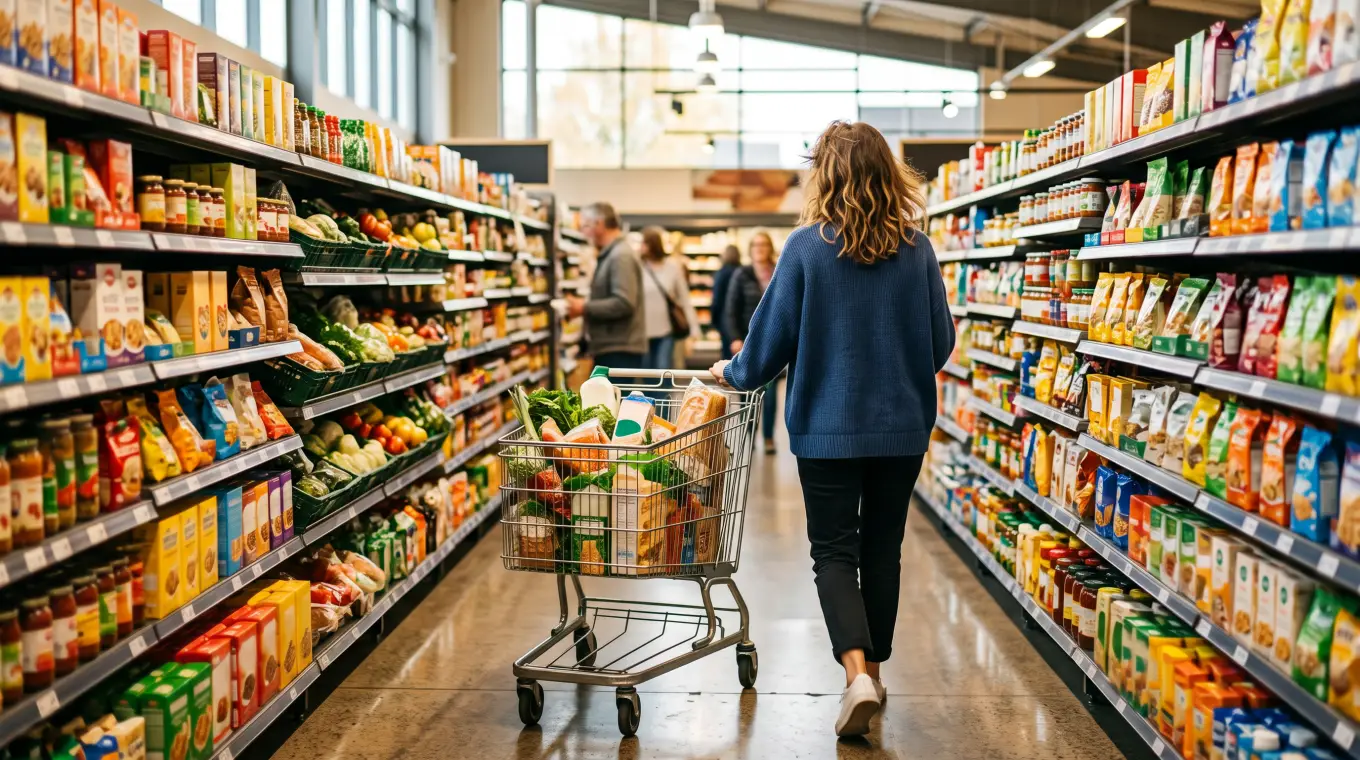
Few household costs are felt as regularly as the weekly grocery bill, and few have changed as visibly in recent years. Canada’s Food Price Report for 2026 — the annual forecast produced by a group of Canadian universities — projects overall food prices rising between 4% and 6% this year. For a family of four, that points to a total annual food bill of roughly $17,572, an increase of close to $1,000 over the previous year. The rate of increase has cooled from the peak, but because each year’s rise builds on the last, the cumulative effect remains significant.
At a glance
- Canada’s Food Price Report 2026 forecasts food prices rising 4% to 6% over the year.
- A family of four is projected to spend about $17,572 on food in 2026, roughly $995 more than in 2025.
- Meat is expected to see one of the largest increases; some fruits and vegetables have offered relief.
- In the July 2026 CPI, food purchased from stores was up 3.1% year-over-year, easing from 3.9% in June.
- Weather, tariffs, and changes in retail and consumer behaviour are all cited as drivers.
Why food still costs more
Food inflation reflects a chain of costs that stretches from field to shelf. The Food Price Report and other analyses point to several forces at work in 2026: global weather events that disrupt supply, the inflationary impact of tariffs on imported goods and inputs, shifting retail business models, and changes in how consumers shop. Categories move at different speeds — meat is expected to rise faster than the overall average, while some fruits and vegetables have actually eased, offering rare relief at the checkout.
There is also a timing effect that can be counterintuitive. The Bank of Canada has noted that it can take six to nine months for cost pressures to be fully reflected in grocery prices. That lag means the prices shoppers see today partly reflect costs incurred months ago, and it is one reason food prices can keep climbing even as broader inflation cools.
The gap between the headline and the receipt
It is worth separating two numbers that often get confused. The Food Price Report’s 4% to 6% is a forecast for the year ahead. The monthly Consumer Price Index, by contrast, measures what has already happened: in July 2026, food purchased from stores was up 3.1% year-over-year, a slower pace than the 3.9% recorded in June. A moderation in the CPI figure does not mean prices are falling — it means they are rising more slowly. Over five years, food has become substantially more expensive, which is why the cumulative pinch persists even in a year of milder increases.
Where households can still save
No shopping strategy erases food inflation, but several habits can soften its impact:
- Plan meals and lists. Shopping to a plan reduces impulse buys and waste, one of the biggest hidden costs.
- Check unit prices. The per-100g or per-litre price on the shelf tag reveals which size or brand is genuinely cheaper.
- Use flyers and loyalty programs. Price-matching, points and timed discounts can add up across a month.
- Consider store brands. Private-label products are often materially cheaper than name brands for comparable items.
- Buy in-season produce. Fruits and vegetables in season are usually cheaper, and some categories have eased in 2026.
- Reduce waste. Storing food well and using leftovers stretches a grocery budget without cutting quality.
Small, repeatable habits beat one big change
Because groceries are a recurring cost, modest savings applied every week compound over a year. Planning, unit-price checks and reducing waste tend to deliver more than any single dramatic switch.
The bigger picture
Grocery prices sit at the intersection of global supply, trade policy and household budgets, which is why they attract so much attention. For 2026, the story is one of slower increases layered on top of several years of steep ones. The forecast rise of 4% to 6% is more manageable than the double-digit spikes of the recent past, but for many households the reference point is not last month — it is how much more the same cart costs than it did a few years ago. That gap is what keeps food front of mind at the checkout.
Sources: Canada’s Food Price Report 2026, Dalhousie University Agri-Food Analytics Lab, Statistics Canada, Consumer Price Index, July 2026 and Global News, 2026 Canadian food report. Forecasts and figures reflect the data available at publication and can change.
This article is for general information only and does not constitute financial advice. Price forecasts are estimates that can change with weather, trade and market conditions. Actual costs vary by household, region and shopping habits.